What Cognism's Native HubSpot 2-Way Sync Changes for Teams Fighting Duplicate Records
Cognism's February 2026 native HubSpot 2-Way Sync gives bi-directional visibility between the two platforms, preventing duplicate creation at the source. The 80% duplicate reduction claim is a vendor projection, not a measured result.
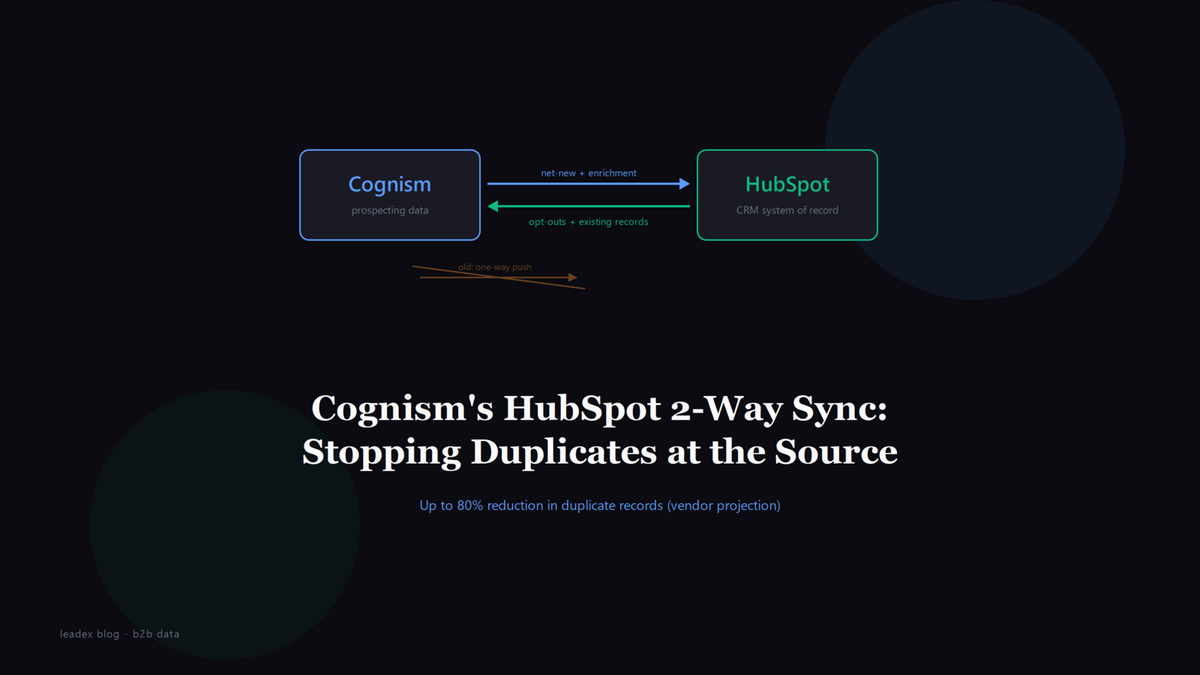
Cognism launched a native HubSpot 2-Way Sync on February 17, 2026, and the headline change is not another data source or a deeper contact database. It is direction. For years the standard Cognism-to-HubSpot integration pushed records one way - out of Cognism, into the CRM - and left deduplication to whatever rules HubSpot had configured on the receiving end. The 2-Way Sync flips that: Cognism can now see what is already in HubSpot before it exports anything, which means the duplicate gets stopped at the source instead of created and merged after the fact.
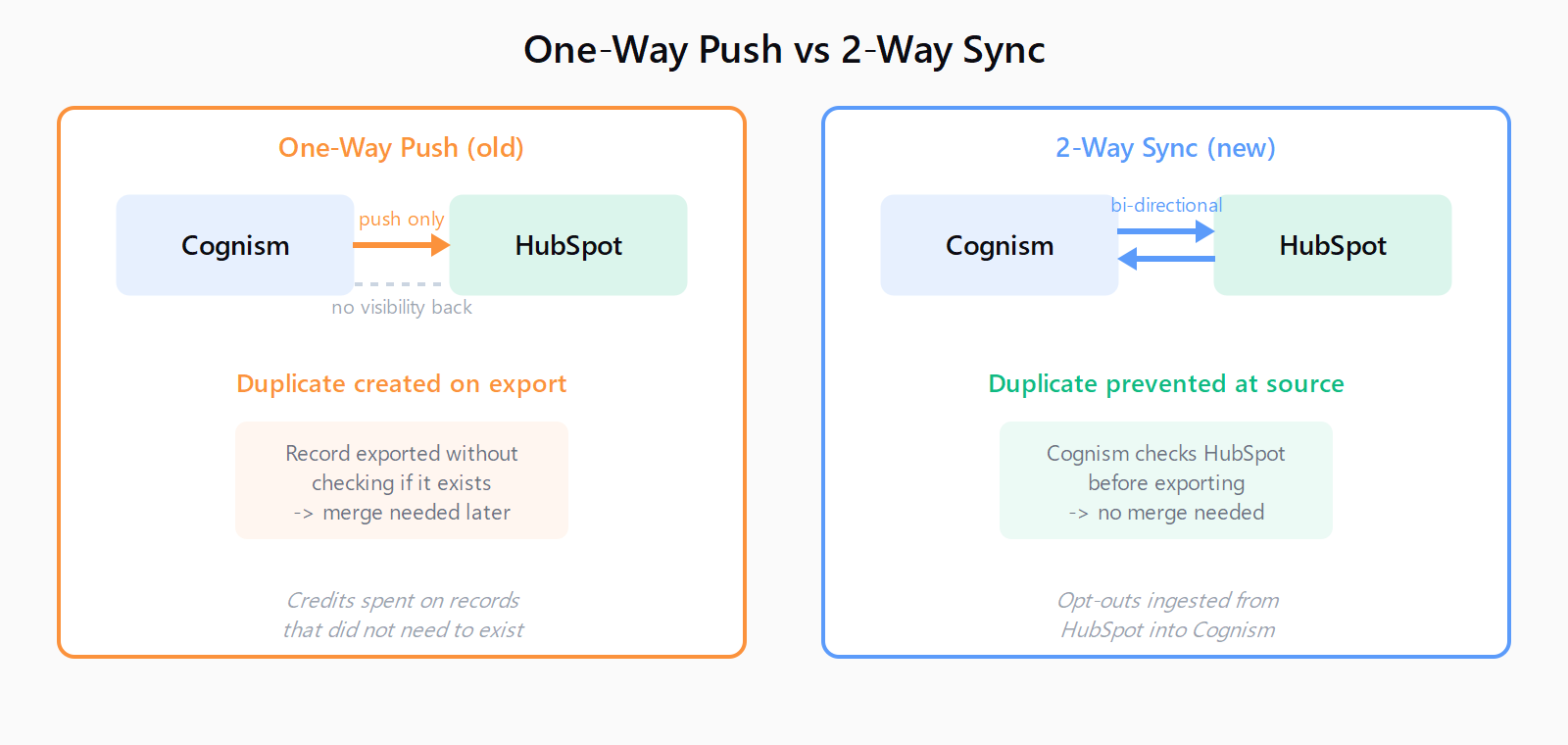
The mechanism is straightforward. The sync provides bi-directional visibility between the two platforms, so a user browsing Cognism sees whether a contact or company already exists in HubSpot before hitting export. Cognism's announcement frames this as preventing duplicate creation, protecting ownership rules, and avoiding wasted credits - the last point mattering more than it sounds, because every Cognism export that creates a duplicate in HubSpot is a credit spent on a record that did not need to exist. John Herbert, Director of Product Management at Cognism, put the framing this way:
Effective GTM requires clarity [...] teams to instantly filter for net-new targets while maintaining full CRM compliance.
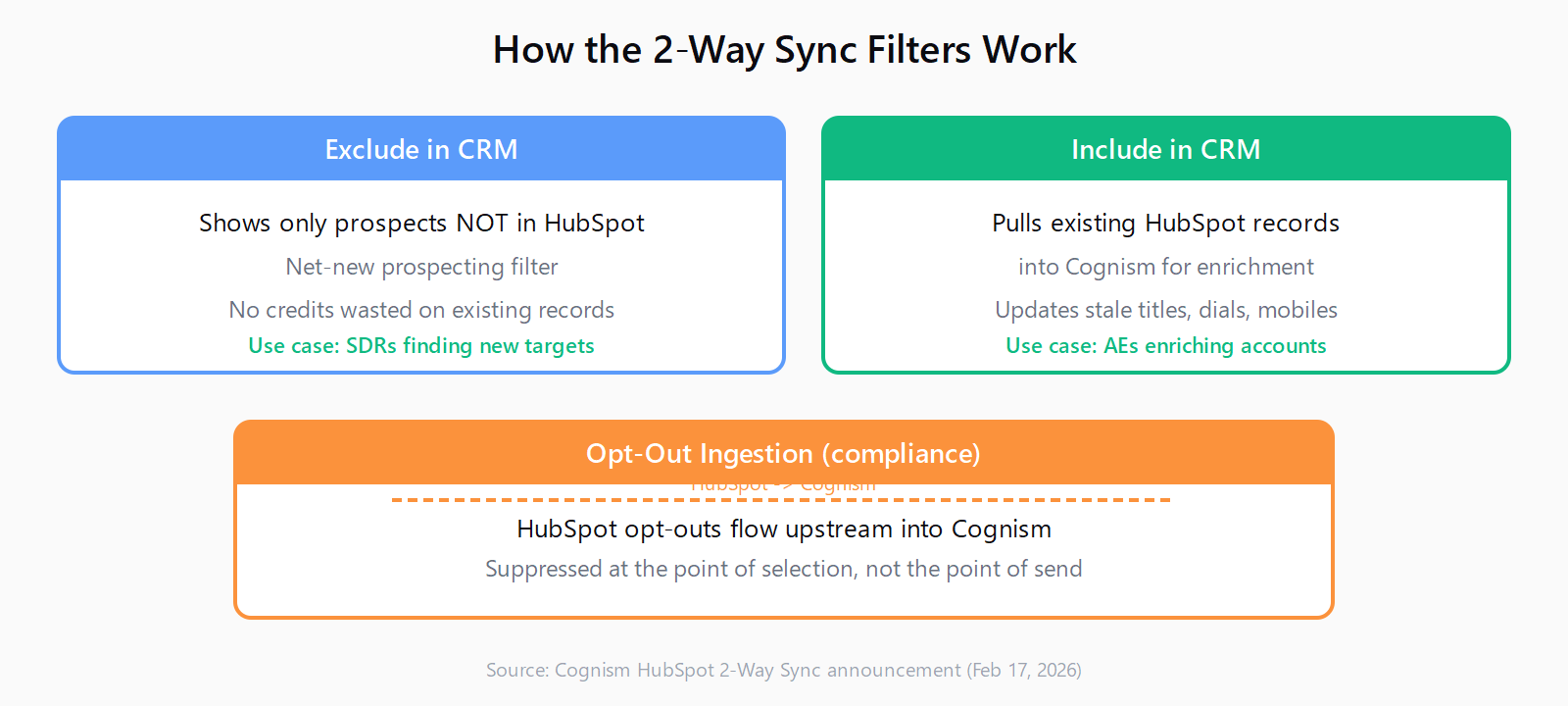
The practical implementation is two filters that sit on top of the sync: "Exclude in CRM" surfaces only prospects that do not already exist in HubSpot, and "Include in CRM" does the inverse, pulling existing CRM records into Cognism for enrichment. The first is the net-new prospecting filter; the second is the data-freshness filter. Together they replace a workflow that most RevOps teams have built by hand - export from Cognism, import to HubSpot, run a dedup pass, reconcile the survivors - with a single sync that checks existence before the export ever happens.
This is a structural fix for a problem that teams have been solving tactically. The manual Cognism-to-HubSpot field mapping approach we covered earlier this year is the one-way-push version of the same workflow: you configure field mapping, set up dedup rules, and accept that some percentage of records will slip through and need merging. HubSpot's own AI duplicate management dashboard is the other half of that tactical stack - a tool for cleaning up duplicates after they are created. The 2-Way Sync aims to make both less necessary by preventing the duplicate from entering the CRM in the first place.
The claim that matters most is the number Cognism puts on it: customers adopting the sync should see "up to 80% reduction in duplicate records." That is a vendor projection, not a measured result - the announcement also projects 50-70% faster prospect-to-CRM data entry and a 20-30% increase in SDR outreach activity per day, and all three sit in the same register of expected-impact language rather than cited research. The 80% figure is plausible (I believe most duplicate creation in a one-way push stems from the exporter not knowing the record already exists, which is exactly what the sync fixes), but teams evaluating it should treat the number as a ceiling, not a baseline. The actual reduction depends on how clean the existing HubSpot database is before the sync turns on - a CRM that already has duplicates will still have them after the sync starts; it just stops accumulating new ones.
The risks of a 2-way sync are the ones any bi-directional integration introduces: conflict resolution when the same field is edited in both systems, sync lag that lets a rep act on stale state, and ownership rule enforcement that has to be configured correctly on both sides or the sync will overwrite a record one team owns with data another team entered. Cognism's announcement does not specify a sync interval or how field-level conflicts are resolved when Cognism and HubSpot disagree on, say, a contact's job title - and for a record that changed in both systems between sync cycles, "last write wins" is the default most integrations fall back to, which is not always the right answer. For teams that have spent months tuning their HubSpot dedup rules and ownership assignments, turning on a 2-way sync is not a configuration change. It is a data governance decision that should come with a rollback plan and a test against a sandbox portal before it touches the production CRM. The 80% duplicate reduction does not mean much if the sync introduces a new class of field-level conflicts nobody has a process for resolving.
The compliance angle is less flashy but more durable. The sync ingests customer-specific opt-outs from HubSpot into Cognism, which means a contact who opted out in HubSpot disappears from Cognism's prospecting views. In a one-way push, opt-out state lives in the CRM and the prospecting tool has no visibility into it - the rep sees the contact in Cognism, exports it, and the opt-out is only enforced when HubSpot's send logic catches it downstream. Pulling the opt-out upstream into the prospecting tool closes that gap at the point of selection rather than the point of send. For teams operating under GDPR or CCPA, that is the difference between "we suppressed the send" and "we never selected the record."
What the sync does not solve is the cross-provider duplicate problem. A team using Cognism alongside Apollo, Lusha, or ZoomInfo still has the same record exported from multiple data providers into the same HubSpot instance, and the 2-Way Sync only checks Cognism's view against HubSpot - not against Apollo's or Lusha's. The multi-provider duplicate is a CRM-side dedup problem regardless of which provider's sync you adopt, which is why the sync documentation is careful to frame the feature as CRM hygiene, not cross-provider dedup. Cognism says the sync "lays the groundwork for a series of enhancements to Cognism's more advanced enrichment solutions later in 2026," which suggests the 2-way visibility is a platform play - the sync is the foundation, not the finished product.
This is the kind of seam between enrichment and CRM hygiene where the underlying data quality matters more than the sync mechanism. A 2-way sync that checks Cognism against HubSpot is only as useful as the records in HubSpot are current - a stale CRM with outdated job titles and departed contacts will pass the "already exists" check and block the enrichment that would have updated the record. We run into this at Leadex because the same discovery-to-enrichment pipeline that builds a prospect list is what determines whether the CRM record it syncs against is fresh enough to be worth keeping - Leadex pushes company and contact enrichment through the provider the team already pays for, and every row carries a source URL and timestamp, so the sync decision is traceable rather than a blind merge. A 2-way sync that cannot tell whether the existing CRM record was enriched last week or last quarter is solving half the problem.
The honest read on the launch is that it is a late but correct move. Native bi-directional CRM sync has been table stakes for enterprise data providers for years - ZoomInfo, Apollo, and Lusha all have some version of it - and Cognism's one-way push was the kind of gap that shows up in renewal conversations. The 80% duplicate reduction claim will need customer-reported data to land as more than marketing. But the structural argument - that a prospecting tool should see the CRM before it exports - is hard to argue against, and the opt-out ingestion alone makes the sync worth turning on for any team already paying for both platforms. The teams that should pay the closest attention are the ones still running the manual field-mapping playbook: the 2-Way Sync does not make that workflow obsolete overnight, but it does make the "export and hope" step look a lot less defensible.