What the Clari-Salesloft Merger Means for Your 2026 Renewal
Clari and Salesloft merged into one Revenue AI company, but six months on the joint product is still two products. Why the renewal, not the merger, is your decision point.
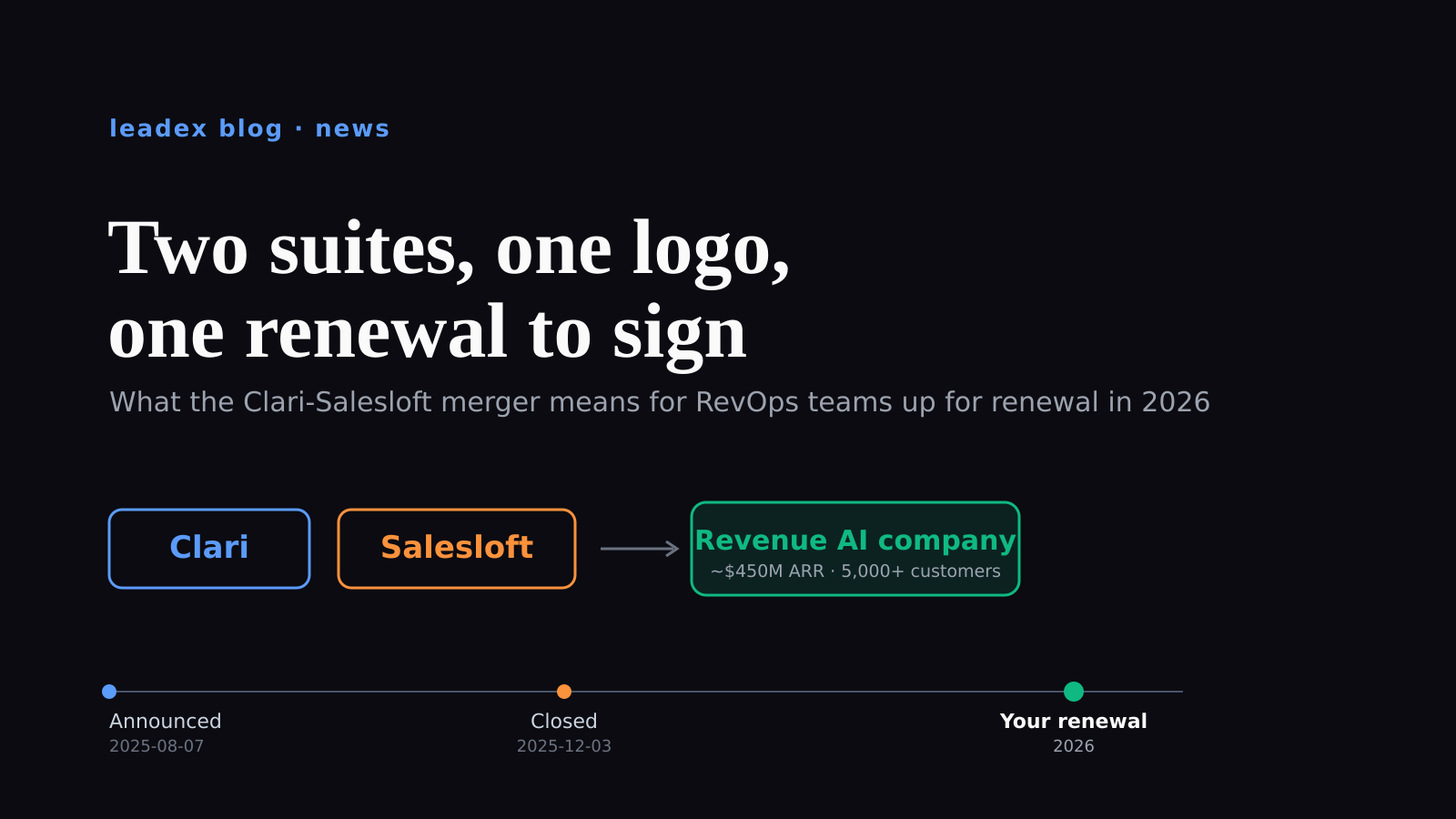
If you run RevOps and a Clari or Salesloft renewal lands on your desk in 2026, the question isn't whether the software still works. It's whether you're now signing a multi-year contract with a company that hasn't finished deciding what it is. The two vendors announced their merger on 7 August 2025 and closed it on 3 December 2025, with Steve Cox installed as CEO of the combined company - not Clari's Andy Byrne, who the August press release had said would lead. Six months on, the joint product is still mostly two products.
The framing in the announcement was enormous. Two "Revenue Orchestration" category leaders, over 5,000 customers including Adobe, IBM, 3M, Zoom and Shopify, "$10 trillion in annual revenue under management," more than 10 billion revenue actions and 1 trillion data signals fed into what Cox now calls the "Predictive Revenue System." Strip out the dataset poetry and the commercial shape is simpler: roughly $450 million in combined ARR, a doubled R&D budget, and the largest go-to-market org in the category, pointed at an eventual IPO. That is a scaling play. It is not, yet, a new piece of software you can buy.
I find the analyst read more useful than either the press release or the customer FAQ, because it names the part that affects your renewal. Forrester principal analyst Anthony McPartlin looked at the same deal in August and was blunt about the seams:
Integrating these two overlapping platforms would appear to be potentially a lengthy, iterative process, requiring tough decisions on technology consolidation while keeping customers satisfied.
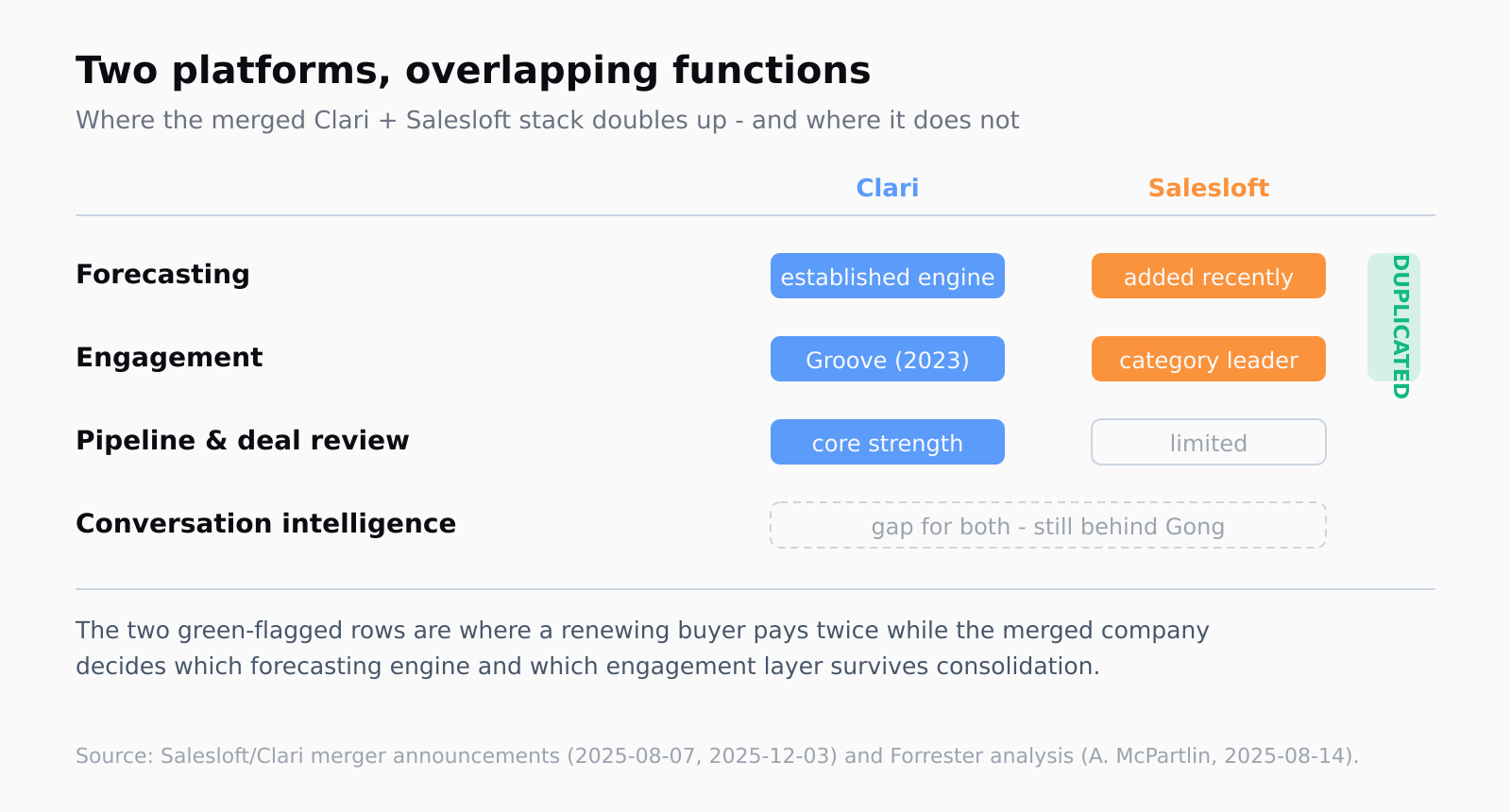
The overlap is the whole point. Clari built its name on forecasting; Salesloft added forecasting of its own in recent years. Salesloft leads on engagement; Clari bought Groove in 2023 to get there too. So the merged entity arrives with two forecasting engines and two engagement layers, and McPartlin's read is that "no major new AI capabilities emerge from the deal" in the near term - the upside is a longer-term bet on the combined data corpus, not a feature you'll see this renewal cycle. He calls the whole thing "a high-risk, high-reward gambit requiring exceptional leadership." The reward is real. The risk is the part you sign for.
That risk has a name that gets passed quietly to customers: the integration tax. When two overlapping suites merge, someone eventually decides which forecasting engine survives, which engagement layer gets deprecated, which admin console you retrain your team on. Those decisions take quarters, sometimes years, and during that window the people paying for both platforms are the ones absorbing the friction - duplicate seats, parallel data models, a roadmap that reads "coming soon" where it used to read "shipped." McPartlin even floats that a bifurcated approach may emerge, with Salesloft serving frontline reps and Clari serving management - which, if it holds, means the "unified" platform is two products wearing one logo for a while longer.
The bull case deserves a fair hearing, because it's not nothing. Doubling the R&D budget is a real commitment, and the combined data corpus - 10 billion revenue actions, a trillion signals - is the kind of training input a single vendor genuinely can't assemble alone. If you believe revenue forecasting and engagement are about to be rewritten by models trained on first-party revenue data, this merger puts more of that data under one roof than anyone else has. Cox's pitch is that the scale itself is the moat: more data, more workflows, a flywheel. The skeptic's reply is that a flywheel is a 2027 story and your renewal is a 2026 decision, and "trust the corpus" is a harder sell when the same analyst note says no major new AI capability shipped from the deal in the first place. Both can be true. You're being asked to pay suite prices now for an upside that's still a slide.
The reassuring news, and it is genuinely reassuring, is that nothing breaks on day one. The customer FAQ Salesloft published is clear that existing contracts, pricing, and renewal dates aren't affected by the merger in the short term. Your sequences still send, your forecast rolls up, your Groove or Rhythm configuration keeps running. So this isn't a fire drill. It's a quieter problem: the renewal you sign in 2026 is a bet on a roadmap that doesn't exist in shipped form yet, and the vendor's own incentive is to get you to commit to the suite before the consolidation decisions become visible. (I believe) the right posture is neither panic nor autopilot - it's to treat this renewal exactly like you'd treat any vendor that just told you its product is about to change underneath you.
Concretely, that means doing the unglamorous audit before you re-sign. Count the seats you actually use against the seats you pay for - merged companies are where seat sprawl goes to hide, because nobody owns the overlap. Map which capabilities you rely on to which underlying platform, so that when one of them gets deprecated you know whether it's load-bearing for you. Ask, in writing, where Groove integration is heading and whether the forecasting engine you depend on is the one that survives. This is the same muscle as when you audit the data before a renewal on any other vendor - except here the thing you're auditing isn't data freshness, it's roadmap certainty, and there's less of it than usual.
This is also not happening in isolation, which is the part worth sitting with. The outbound stack has been consolidating for a year. Clay's $5B tender pulled enrichment workflows toward one gravity well; Salesloft's own product surface kept absorbing functions, which is why Salesloft's Rhythm queue now wants to be the place your reps start their day. The Clari merger is the same motion at the platform tier: fewer, bigger suites, each trying to be the system of record for "revenue." For a buyer, more consolidation upstream means fewer independent vendors to play against each other at renewal, and more of your stack riding on one company's integration decisions.
This is the seam we think about constantly at Leadex, because the consolidation argument cuts both ways. A unified suite is convenient right up until the renewal where you realize you're paying per seat for two forecasting engines and can't unbundle the half you use. Leadex sits at the discovery-and-enrichment end of the pipeline rather than the forecasting end, and it's deliberately the inverse of suite lock-in: bring your own Apollo and CRM keys, describe the ICP in a chat, get a deduped list out. The point isn't that it competes with a revenue-orchestration platform - it doesn't - it's that not every part of your stack has to be a multi-year seat commitment to a company mid-merger. Some of it can be the part you can walk away from.
None of this is a reason to churn off Clari or Salesloft. If forecasting or engagement is doing real work for your team, the merger doesn't change that next quarter, and the doubled R&D budget might genuinely pay off in 2027. It's a reason to renew with your eyes open: shorter terms where you can get them, written answers on the consolidation roadmap, and a seat count that reflects what you use rather than what you bought when the two platforms were separate. The "Predictive Revenue System" may well arrive. The renewal arrives first.