Why Artisan Ava Sends Thousands of Emails, Books No Meetings
Ava's volume is rarely the problem. Diagnose deliverability, data, copy, and offer in order before you blame the AI.
Ava is the AI SDR I get asked about most, usually right after someone shows me a dashboard with 4,000 sends and an empty calendar. The pattern repeats: personalization looks sharp, volume climbs, replies hover near zero. I have seen the same arc described for inbound and outbound AI SDRs are not substitutes, and Ava sits firmly on the outbound side of that split, so judging her by inbound expectations is the first mistake.
On paper the setup is simple. You hand Ava your ICP, she finds prospects, writes sequences, sends, handles replies, and books meetings. Artisan raised a $25 million Series A led by Glade Brook Capital in April 2025 and told TechCrunch she served 250 companies at $5 million in annual recurring revenue. Ava 2.0 followed as the enterprise relaunch in May 2026. As of September 2026 the question buyers actually ask is narrower: why does all that sending produce no meetings, and which of the four usual causes is yours?
Why does Ava send thousands of emails but book zero meetings?
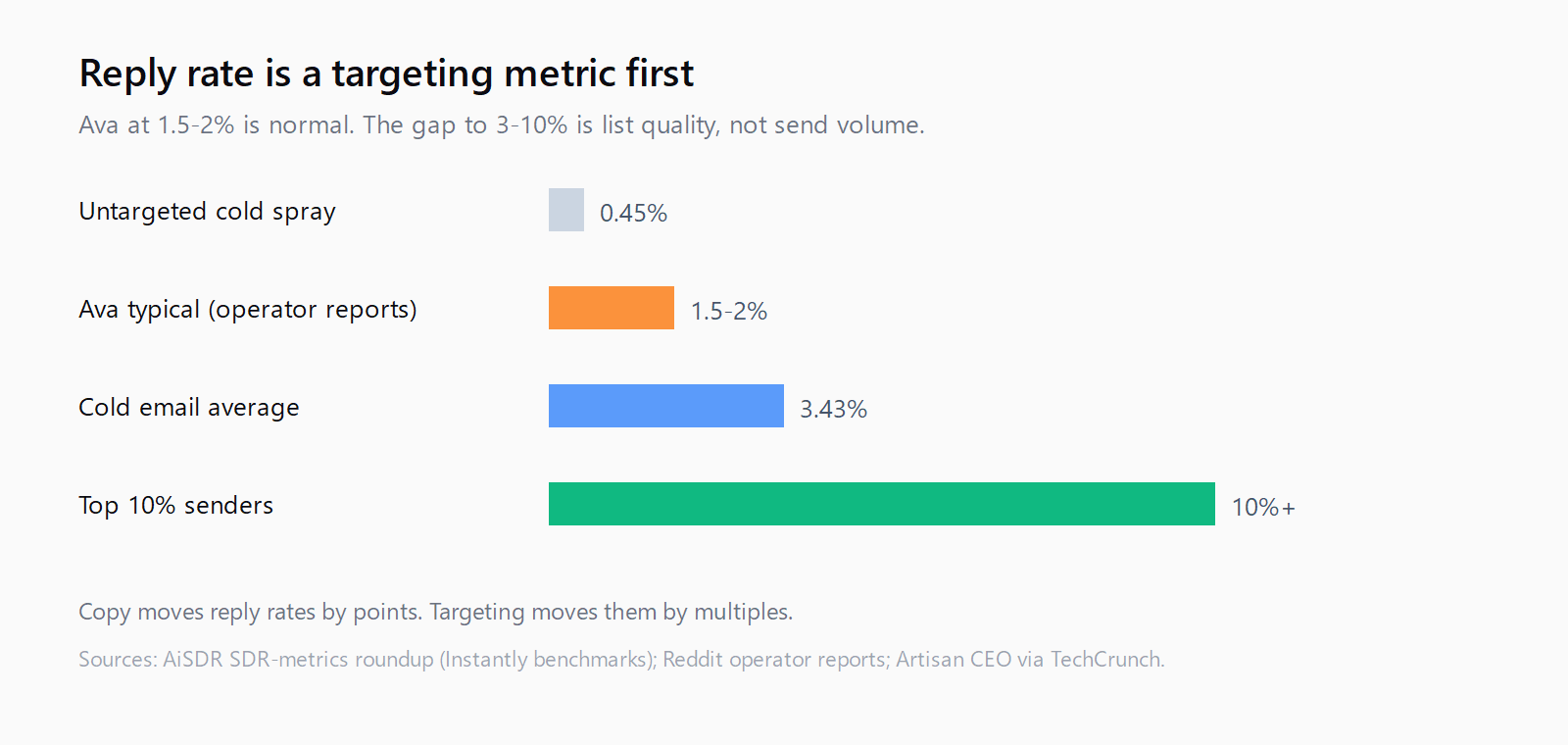
The short answer is that sending is the one part Ava never struggles with, so volume hides the real break. Meetings need four things in a row: the mail reaches the inbox, the address is real, the copy reads human, and the offer earns a reply. Miss any one and the other three stop mattering. Most zero-meeting deployments I have read about miss at least two at once, which is why turning up the send dial never helps.
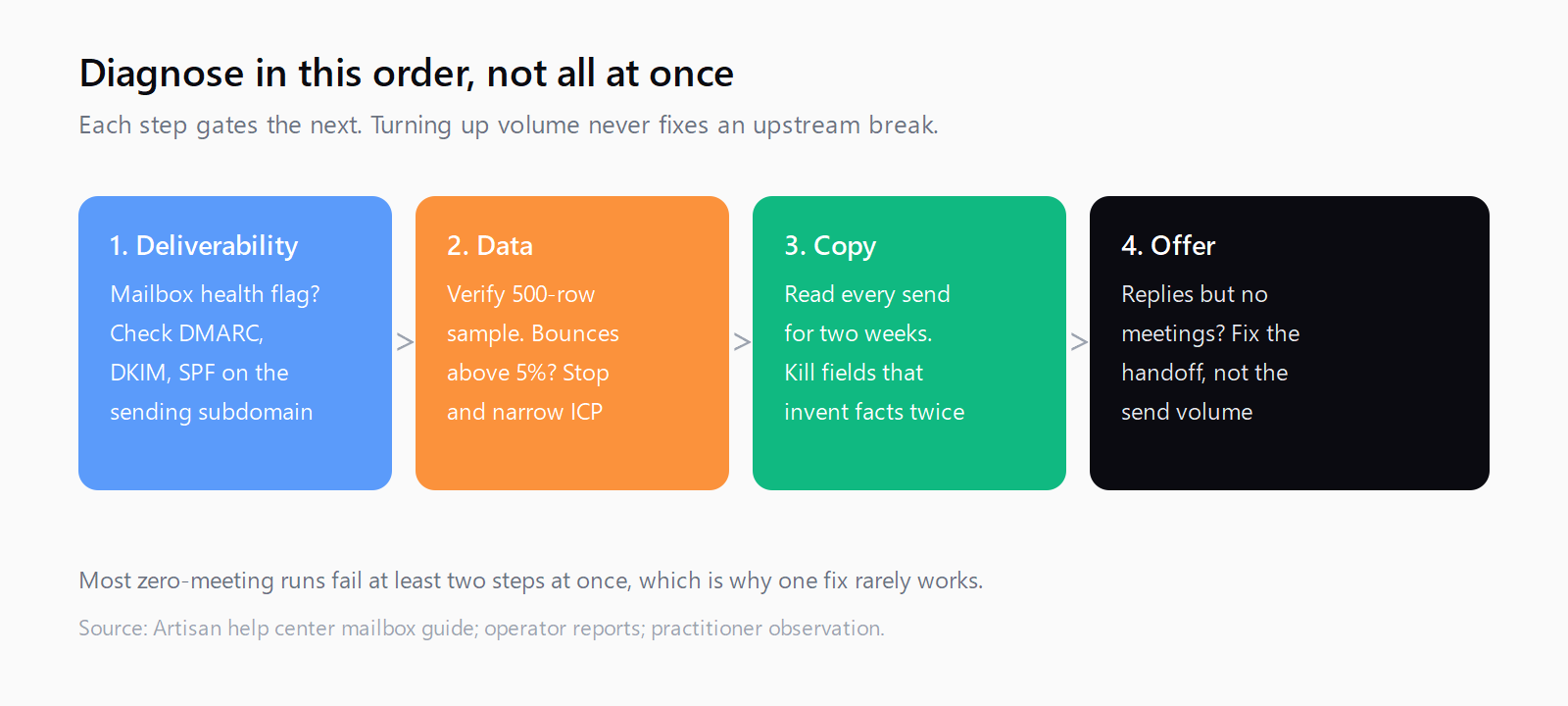
The honest baseline helps here. One operator running Ava in production reported reply rates "hovering around 1.5-2%" in a widely shared Reddit thread reviewing Ava, with solid personalization but weak meeting output. Artisan CEO Jaspar Carmichael-Jack, founder and CEO of Artisan, told TechCrunch that first-generation AI SDRs "get a pretty low response rate" and suffer "relatively high churn," putting the sweet spot at about a 1% response rate in that same April 2025 interview. So a 1.5% reply rate is not the disaster; zero meetings from it is the signal that something downstream of the reply is broken.
The key paragraph from Artisan's own docs frames the whole fix list:
Check that your DMARC, DKIM, and SPF records are correctly configured. If we detect a drop in mailbox health, Ava will reduce the number of leads contacted from that address to protect your deliverability.
That is from Artisan's mailbox health warning guide, and it tells you more than it seems. Ava throttles herself when health drops, which means your "she stopped sending" moment and your "she sends but nobody replies" moment can share one root cause. My read: check deliverability first, data second, copy third, offer last. That order matches how often each one is actually at fault (I believe).
How to fix the Artisan mailbox health urgent warning
Start in the Artisan help center, not in the sequence editor. The mailbox health warning guide splits the fix by mailbox type: on customer-owned mailboxes you check DMARC, DKIM, and SPF yourself, while on Artisan-managed mailboxes you open a support ticket and let them investigate. Either way the symptom is the same, an urgent flag plus shrinking send volume, because Ava deliberately contacts fewer leads per address once health dips.
Verify authentication with a real lookup, not by eyeballing DNS once. Senders whose mail fails SPF, DKIM, or DMARC get treated as suspect before a human ever sees the message, a point Artisan's own email deliverability checklist walks through step by step. I check alignment on the exact sending subdomain, not the root domain, since cold mail almost always sends from a subdomain (!).
Then look at what changed in the last 30 days, because mailbox health is a trend, not a snapshot. New subdomain without warmup, volume spike after onboarding, a batch of bouncy built-in data hitting fresh inboxes: any of these can drag health down in a week. Keep daily volume per mailbox modest while health recovers, and do not launch a second campaign on the same domain to "make up" the sends. That is how a dip becomes a block.
If the flag stays up after authentication passes, stop treating it as a settings bug. Persistent urgent health with correct records usually means the content or the list is generating spam complaints and bounces, which the next two sections cover. The mailbox is the messenger here, not the message. For the broader pattern of AI-written mail tripping filters, the sequence in why AI SDR emails land in spam is the closest cousin to this one and worth reading alongside.
How to stop bounces from Ava built-in contact data
Bad data is the most common zero-meeting cause I see, and the least fun to admit. One operator put it plainly: "Ava's only as good as the contact info she's working with," reporting lots of bounces and generic info@ addresses from the built-in database, and materially better bounce rates after feeding Ava leads from a prospecting tool instead. That matches the wider market: Apollo's 2026 roundup of AI SDR limits cites Eubrics research finding 60% of sales leaders name poor data quality their top AI adoption challenge, in Apollo's analysis of AI SDR limitations.
The fix is upstream of Ava, which is annoying when you bought an all-in-one. Export a sample of 500 built-in contacts before your next big run and verify them with an independent checker. If more than 5% bounce or resolve to catch-alls and role addresses, do not let Ava send to the rest unverified. Suppression lists, role-address filters, and a verification pass cost far less than a burned domain, and cold email benchmarks make the stakes concrete: untargeted net-new cold mail averages about a 0.45% reply rate across 7.5 million sends measured in 2025, per AiSDR's SDR metrics roundup, while targeted tiers clear multiples of that.
Where teams go wrong is treating database size as quality. A 300-million-contact database can still hold only a handful of correct C-level rows in a niche ICP, a gap multiple reviewers flagged when Ava returned three to seven usable contacts for tight criteria. Narrow the ICP until the sample verifies clean, then widen it one filter at a time.
This is the seam I think about most, because it is exactly where discovery and enrichment meet. Leadex lives at that same seam: you describe the ICP in plain chat, approve a research plan, and the agent browses the open web with semantic search at up to 100 results per call before anything gets enriched or exported. The point is not which tool finds the lead; it is that the finding step and the verifying step share one brain instead of two vendors pointing at each other when bounces spike.
How to keep Ava personalization from going off the rails
Good personalization is the reason teams buy Ava, and weird personalization is a reason they churn. The same operator who praised her LinkedIn-and-news references flagged "off the rails" assumptions in the same breath, and CEO Carmichael-Jack has admitted the early product hallucinated badly enough to make him "cringe in pain" looking back, while claiming the current Ava hallucinates in maybe one in 10,000 emails. I read both as true at once: the median email got much better, and the tail of strange assumptions never fully disappears in autonomous sending.
Audit like SaaStr's Jason Lemkin suggests for AI SDRs generally: read every email Ava sends for the first two weeks, in his AI SDR reality check. Mark each line as human or robotic, and kill any personalization source that invents facts twice. Common offenders are stale funding mentions, guessed tech stacks, and LinkedIn activity stitched to the wrong person.
Then check the offer, because even perfect mail cannot book meetings for a pitch nobody wants. What autonomous AI SDRs still cannot handle makes the structural case: qualification, objection handling, and account strategy still need a human owner, and fully autonomous booking works only where the offer maps to a recognizable pain. If replies arrive but meetings do not, read the replies. "Not relevant" means targeting; "who is this" means data; silence after a positive reply means your handoff is too slow. Carmichael-Jack himself says some customers "will just completely flop" with agentic outbound and Artisan now qualifies harder instead of selling to everyone, which is refreshingly blunt for a vendor CEO.
FAQ
Why is my AI SDR sending emails but booking no meetings?
Because sending is only step one of four: inbox placement, valid addresses, human-sounding copy, and an offer worth replying to. Check them in that order. In Ava deployments the most common pair is degraded mailbox health plus bouncy built-in data, either of which zeroes out meetings on its own.
Why does Artisan Ava show 1.5-2% reply rates?
That range matches both operator reports and Artisan's own framing of a roughly 1% sweet spot for agentic outbound. Treat 1.5% as a normal starting point, then diagnose the reply-to-meeting gap separately: slow follow-up, weak qualification, or calendar friction usually explain it.
How do I clear the Artisan mailbox health urgent warning?
On customer-owned mailboxes, verify DMARC, DKIM, and SPF on the exact sending subdomain, then lower volume while health recovers. On Artisan-managed mailboxes, open a support ticket per the help center guide. If the flag persists with correct records, the cause is usually list quality or complaint-generating copy, not DNS.
Should I feed Ava leads from a prospecting tool instead of built-in data?
Yes, if a 500-row verification sample of built-in contacts bounces above 5% or skews toward role addresses. Operators report materially lower bounce rates with externally sourced leads. Verify before every scale-up, narrow the ICP until samples come back clean, and keep suppression lists current.
How much does Artisan Ava cost per booked meeting in 2026?
Entry pricing clusters near $2,000 per month on annual contracts, with mid-market deals running $25,000 to $50,000 per year per third-party comparisons. At a 1.5% reply rate with one in five replies converting, 2,500 monthly sends yield around 7 meetings, or roughly $200 to $300 per meeting before no-show discounting. Confirm current pricing on a demo call since Artisan does not publish full rates.