
Piper vs Ava: Why Inbound and Outbound AI SDRs Are Not Substitutes
Qualified's Piper concierges your website; Artisan's Ava emails 300M contacts. They're not interchangeable. Here's the motion-fit test that picks the right one.
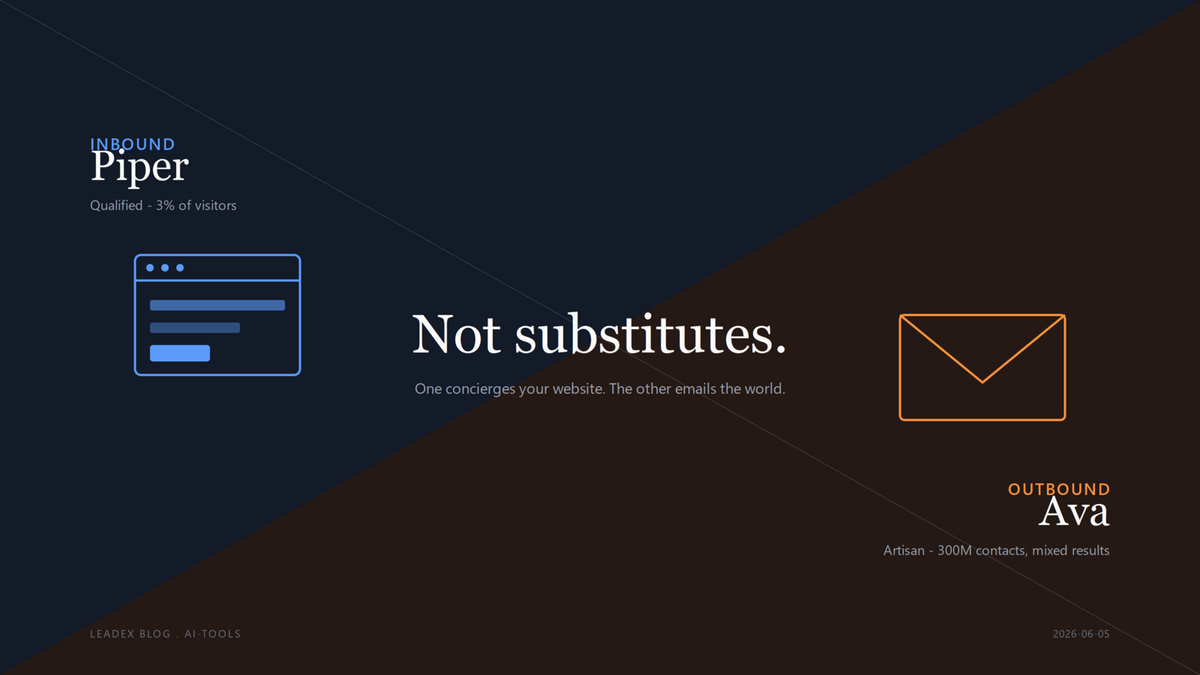
Two of the loudest "AI SDR" pitches in 2026 belong to Qualified's Piper and Artisan's Ava, and I keep watching teams put them on the same evaluation grid as if they were the same product. They are not. Piper is a website concierge that converts the 3% of visitors who start a chat. Ava is an outbound mailer that pulls names from a 300M-contact database and tries to break into inboxes that have never heard of you. Picking one when you needed the other is the cheapest way I know to spend $30k a year on a tool you will rip out at renewal.
The premise of this post: which motion dominates your pipeline today determines which of these (if either) you should buy. I'll walk through how Piper actually works in production, how Ava actually works in production, and the simple test for which side of the line you sit on. The AI SDR category as a whole is still messy enough that "I want an AI SDR" is not a buying signal - it's a research signal.
What Piper actually does (and pointedly doesn't)
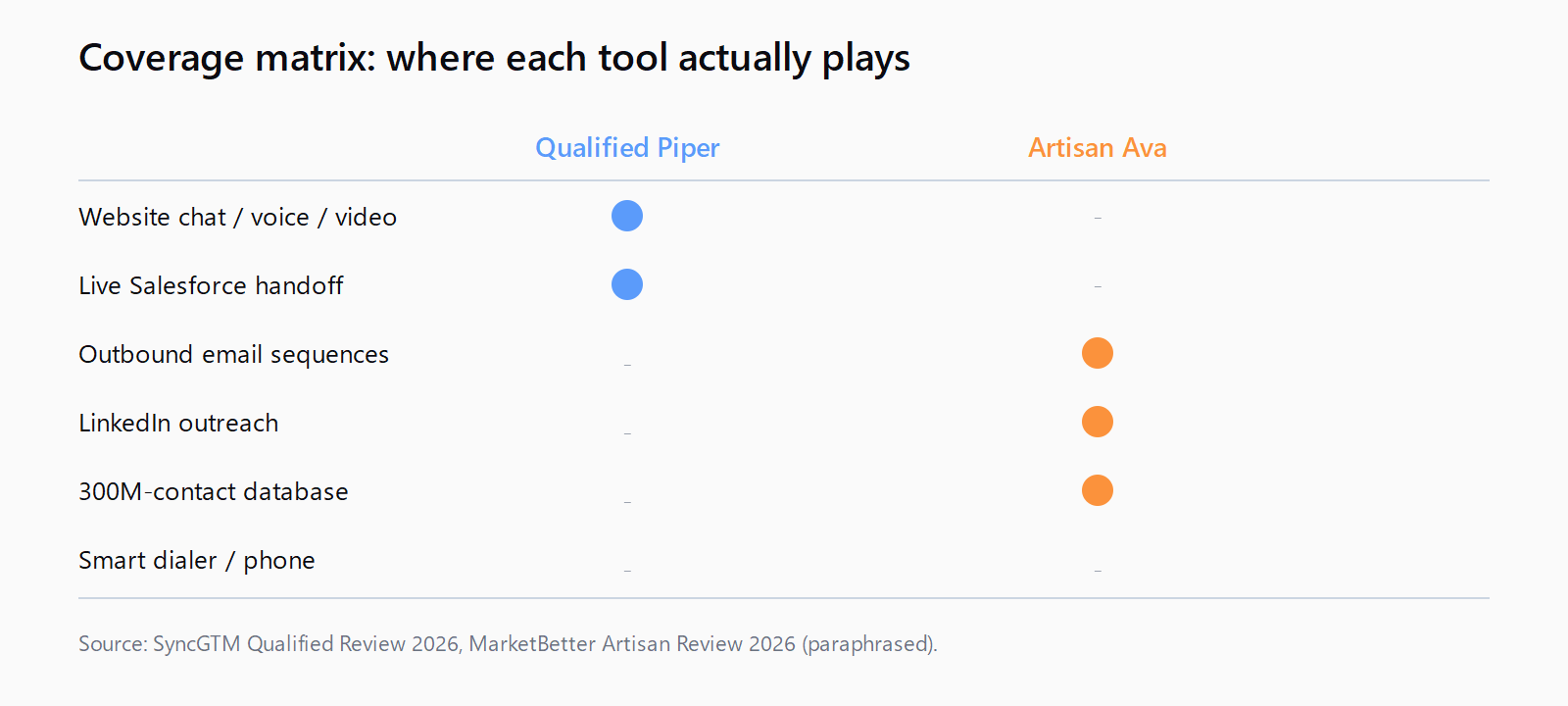
Piper is the AI SDR product from Qualified, the inbound-conversation platform Salesforce announced it was acquiring under a definitive agreement in early 2026. Piper sits on your website and engages visitors in real time over chat, voice, or video, reads live Salesforce data to personalize the greeting (named account routing, owner-aware handoffs), and books meetings straight into rep calendars when the conversation crosses a defined intent threshold. For visitors below that threshold it drops into an email nurture sequence instead.
What Piper does not do is the part teams underestimate. The SyncGTM 2026 review of Qualified is blunt about this:
"No dialer, no LinkedIn, no outbound sequences." Piper engages "the 3% of visitors who start a conversation," leaving "the 97% who browse and leave" unreachable. Additionally, "thousands of potential buyers who never visit your website at all are completely unreachable."
That paragraph is the whole product boundary. Piper is a 4.9/5 on G2 across more than 1,400 reviews, which is genuinely rare in this category and reflects how good it is at the thing it does. It just doesn't do the thing most teams mean when they say "I need an AI SDR." Most teams mean outbound. Piper is inbound.
Two practical consequences. First, Piper is functionally dependent on Salesforce - the review describes the CRM integration as its "moat" and notes that without Salesforce "users lose most of the platform's value." If you run HubSpot, Piper is the wrong shape regardless of motion. Second, you only get returns proportional to your existing inbound volume. A pre-Series-A startup with 800 monthly site visitors will see Piper pay back slowly; a Series-C company with 60,000 monthly site visitors and a real demand-gen budget is the audience it was built for.
What Ava actually does (and where reviewers flinch)
Ava, Artisan's flagship, is on the other side of the line. Ava sources leads from a bundled 300M+ B2B contact database, generates personalized emails, runs multi-channel sequences across email and LinkedIn, classifies replies, and books meetings to the rep's calendar. On paper it sounds like a complete outbound stack in one product.
The 2026 reviews are where the picture gets more textured. The MarketBetter teardown is willing to say things vendors do not, and the lead-quality complaints stack up:
"Several users reported sending 1,000-1,400+ emails and receiving zero replies." [...] "Even users who booked meetings through Ava reported that the leads were poorly qualified." [...] One Reddit user: "The emails read like ChatGPT wrote them for a generic audience. My prospects could spot them immediately."
Two patterns inside those complaints worth separating. The first is the database itself - strong in breadth (300M is a real number), weak in niche depth, where one reviewer reported only 3-7 C-level matches against their specialized ICP. The second is the generation layer - the "spray and pray" failure mode where Ava sends 1,400 emails without the recency logic or buying-signal filter that would have culled the dead list before send. Volume without filtering is just noise (!).
There's also a contract footnote that's worth flagging because I keep hearing it from people who churned: the ColdReach review of Artisan warns about friction on cancellation and auto-renewal - verify your annual terms before you sign, not after.
The motion-fit test: 50% rule
The cleanest way to pick between these is to look at where your current meetings come from. Pull the last 90 days of closed-won and pipeline-generated opportunities and tag each one by its first-touch source. If more than 50% trace to your website (chat, demo form, content download, pricing page), you have an inbound-dominant pipeline and Piper is the candidate worth piloting. If more than 50% trace to outbound sequences, cold email, or event lists, you have an outbound-dominant pipeline and Ava (or one of its competitors) is the candidate, with the caveats above.
The trap is the middle band, where teams are 40% inbound and 60% outbound, or vice versa. The honest answer for that band is usually neither tool right now - pick the side you want to grow, hire a human SDR to run the other side, and revisit AI SDR for the dominant motion in nine months when your numbers are less ambiguous. I have not yet seen a team successfully run both Piper and Ava in parallel, and the integrations don't share a useful surface; they're two separate POs and two separate runbooks.
Where Leadex sits in this picture
This is exactly the seam Leadex was built around. Before either Piper or Ava can do its job, somebody has to define who counts as a prospect - the ICP brief, the niche filters, the open-web research that picks up signals an off-the-shelf database doesn't carry. Leadex is the chat-native research agent that produces that list: describe the ICP in prose, approve the plan, the agent browses the open web, dedupes, and pushes the result to your CRM. Founders use it to build a "first 500-lead list by lunch" without buying into a 300M-contact subscription they only need 3,000 rows of. If you go the Ava route, Leadex is the upstream filter that makes Ava's sequences sit on top of a list you actually trust; if you go the Piper route, Leadex is what builds the target-account list Piper then watches your website for.
What to actually buy on 2026-05-27
If your motion is inbound-dominant and you run Salesforce, Piper is the only product in this comparison worth piloting. The 4.9/5 G2 average is not marketing fluff - it's the practitioner consensus, and the Salesforce acquisition means the integration stops being a third-party connector and starts being the default. If your motion is outbound-dominant and you do not already have a clean, recency-filtered prospect list of your own, Ava is going to amplify the list quality problem, not fix it. Build the list first (this is the part teams skip), then either run Ava on it or run a human SDR on it - both work, neither works on a 300M-record firehose.
And if you find yourself in the middle band, the most expensive mistake is buying both. I have seen exactly one team make that work, and they had a four-person ops team running the integration glue full-time. (I believe) that's not the team you are.
FAQ
Is Qualified Piper available without Salesforce?
No. Qualified's platform is built directly on Salesforce data, and the SyncGTM 2026 review notes that without Salesforce "users lose most of the platform's value." HubSpot and pipeline-only shops should look elsewhere.
How is Ava priced compared to Piper?
Both vendors price by seat plus volume tier and neither publishes a transparent table, but the practitioner reports put Piper in the upper range (mid-five-figures annual at SMB scale) because of the inbound-engagement tier and Ava in the mid-range (five-figures annual) bundled with the 300M-contact database. Get a real quote - published numbers age fast in this category.
Can you run Piper and Ava together?
Technically yes, since they touch different surfaces (Piper on your website, Ava on outbound). In practice the operational overhead of running two AI SDRs in parallel - separate review queues, separate audit cards, separate CRM write paths - eats the time savings either tool was supposed to deliver. Pick the dominant motion and concentrate.
What's the single biggest Ava failure mode reviewers cite?
Generated emails that read as machine-written and lists that include contacts with no recency or intent signal. The MarketBetter review flags 1,000-1,400 emails sent with zero replies as a recurring pattern, and the Reddit-sourced quote - "The emails read like ChatGPT wrote them for a generic audience" - captures the recognizability problem prospects flag inside three seconds.
Does the Salesforce acquisition of Qualified change anything for Piper buyers?
Probably yes, over the next 12 months. Salesforce announced the definitive agreement in early 2026, and the integration that today is Qualified's "moat" will eventually become a Salesforce-native feature. Existing Qualified customers should expect price-bundling changes at renewal; new buyers should expect Piper to be packaged inside Sales Cloud SKUs rather than sold standalone.