What Salesloft's Clari Copilot AI Metrics Actually Track
Salesloft's new AI metrics count activity, not outcomes - here's what they track and what's missing.
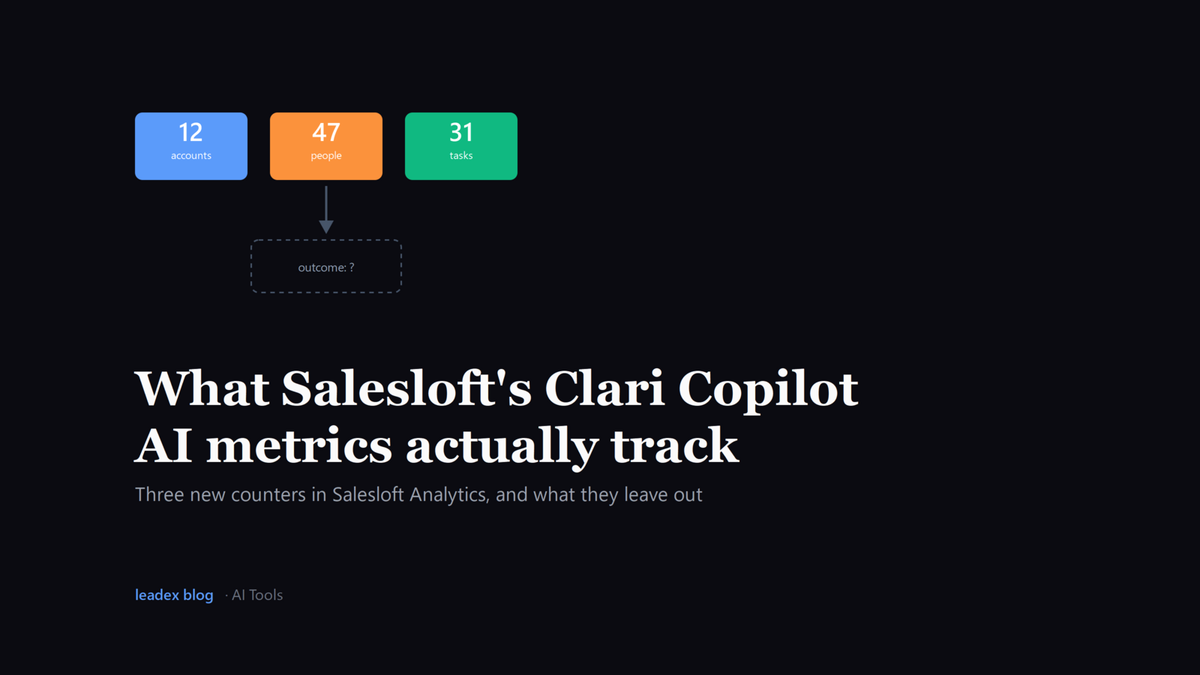
I wrote about Salesloft Rhythm's AI-prioritized queue a few weeks ago, and the same pattern shows up again here: Salesloft keeps shipping AI surfaces faster than most buyers can evaluate what they actually do. The latest one, folded into the June 2026 release, moves Clari Copilot directly into the Salesloft navigation and adds three new AI metrics to Salesloft Analytics. Both parts are worth more than a changelog skim.
The mechanics first: Clari Copilot, the conversation-intelligence product Clari acquired in 2022 and brought into the combined company when Clari and Salesloft merged on December 3, 2025, no longer requires a separate login. Recordings, transcripts, AI summaries, and action items now flow into Salesloft's Activity Feed, Deal Summary Agent, Meeting Prep and Follow-Up Plays, and Ask Salesloft. Per the June 2026 release notes, the integration also adds AI Smart Chapters, Revenue Critical Moments, live Battlecards, voice fingerprinting, and an admin command center with team adoption reporting - none of it previously available inside Salesloft's own Conversations product. None of it is free, either: it requires an Advanced-or-higher license tier and a unified Okta SSO setup, and it's scoped to new Salesloft customers and new Clari Copilot implementations, not existing seats on either side. The same June release also lets Clari Copilot automatically score recorded video calls against scorecard templates - it analyzes the transcript, assigns a numeric score to each scorecard question, and highlights the moments in the recording that justify the score, which is a genuinely useful coaching primitive if the scorecard questions are any good and a source of noise if they aren't.
The integration ships alongside a related but separate move: a Model Context Protocol server, announced in April, that lets Claude, ChatGPT, Microsoft Copilot, Gemini, and Salesforce Agentforce read live Salesloft pipeline movement, deal activity, and customer interactions directly. Steve Cox, CEO of Clari + Salesloft, framed the motivation plainly: "the gap between insight and action is often where deals stall or slip." Kylie Fuentes, the company's Chief Product Officer, put the larger ambition next to it: "most AI conversations in revenue are still about what the AI can see." The stated use cases are specific - generating a structured implementation plan the moment a deal closes, connecting call sentiment to support-ticket volume to trigger a play, unifying engagement data with product usage to flag customer risk before a renewal is at stake. Andy Dorling, Sales Enablement Manager at GWI, is quoted saying reps are "generating emails with AI and sending them without ever leaving Clari"; Spencer Hercus at Lucid reported "significant time and energy savings" from the same rollout - _significant_ doing a lot of unquantified work in that sentence, which is its own small tell.
The three new Analytics metrics are the more interesting part, because they answer a question a press release never does: what, exactly, shows up on a manager's dashboard. The release notes describe them like this:
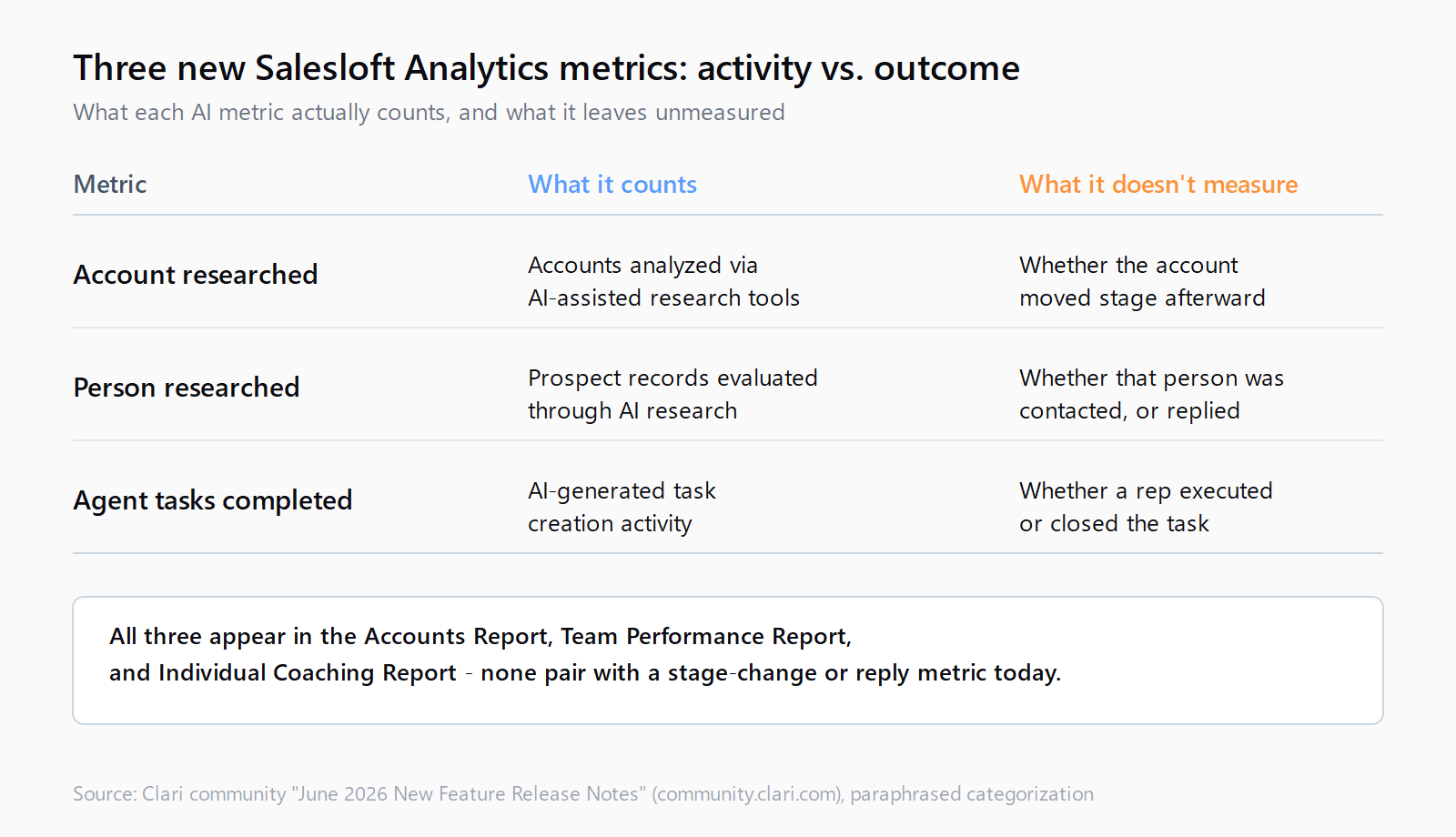
Three AI metrics are now available across key Salesloft Analytics reports: Account researched - tracks how many accounts teams analyze using AI-assisted research tools. Person researched - measures the volume of individual prospect records evaluated through AI research capabilities. Agent tasks completed - records AI-generated task creation activity. These metrics appear in the Accounts Report, Team Performance Report, and Individual Coaching Report.
Read that list twice and notice what's missing: none of the three touch an outcome. Account researched and person researched count AI-assisted lookups, not whether the lookup changed anything about the deal. This is the same shape as the conversation-intelligence seat sprawl building across the category - I covered the mechanics of that when HubSpot's Frame AI acquisition put pressure on teams paying for a second conversation-intelligence seat - and the tell repeats here: a vendor ships an activity counter and calls it an AI metric, when it's really an adoption metric wearing an AI metric's clothes.
Agent tasks completed is the one I'd watch most closely, because "completed" means the write completed, not that a human closed the loop on it. That's the same gap I found when cataloguing what autonomous AI SDRs still cannot handle: an agent proposing a next step is a different achievement than a rep executing it, and a metric that only counts the proposal will always look healthier than the pipeline actually is. A coaching report built on this number can show a rep at 100% "agent tasks completed" while every one of those tasks sits untouched in a queue.
We think about this distinction a lot, because it's the failure mode Leadex is built to avoid on the research side. The agent shows you a research plan you approve before it touches the web, not a tally of completed lookups after the fact, so the number that would actually matter here - did the research match the brief - gets checked before the run, not audited afterward. A dashboard that rewards "accounts researched" can be satisfied by an agent that researched the wrong fifty accounts quickly; a plan you sign off on first prevents that by construction, which is cheaper than catching it in a coaching review three weeks later.
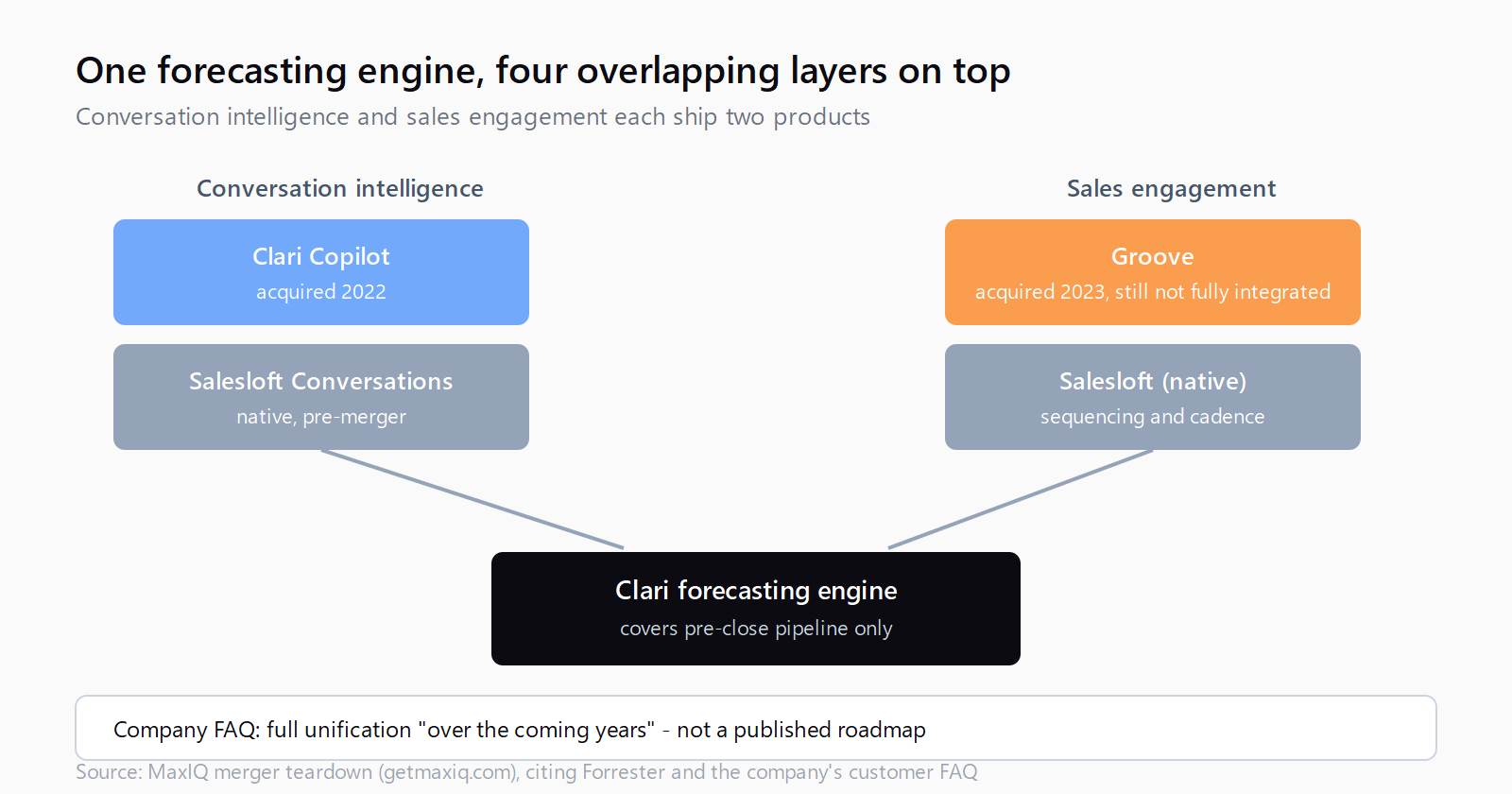
The skeptical read, and I think it's the correct one (I believe the timeline backs this up), comes from a competitor's own teardown of the merger. The combined company is running two conversation-intelligence systems side by side - Clari Copilot and Salesloft's native Conversations - plus two overlapping sales-engagement layers, Groove and Salesloft itself. MaxIQ's analysis quotes Forrester describing the arrangement as raising "more questions than answers" given "substantial technology overlap," and notes that Groove, acquired back in 2023, still isn't fully folded in three years on - a bad precedent for how fast Clari Copilot and native Conversations actually converge. Asked about a unification timeline, the company's own customer FAQ says updates arrive "as we kick off 2026" and full unification happens "over the coming years," which MaxIQ calls, not unfairly, a placeholder rather than a plan. Clari's forecasting layer also stops at the close line: renewals, expansion, and onboarding - the 40-70% of enterprise software revenue that lives post-sale - stay outside what either product measures, AI metrics included.
The economics reinforce the skepticism. MaxIQ pegs the combined platform's base pricing at $100-$200 or more per user monthly, on top of $15,000-$25,000 in professional services and an implementation window running weeks to several months - and the post-merger pricing model for the newly bundled Copilot access still isn't published. One user quoted in that piece put the actual day-to-day experience more bluntly than any vendor page would: "I have to maintain my own separate spreadsheet to track deals because I can only capture what my leaders want to see about a deal." That's the practical cost of a metrics layer designed around what leadership wants visible rather than what a rep needs to do the job - the new AI metrics inherit that same design bias, just with an AI label attached.
As of this writing in July 2026, for anyone actually pulling these reports: the three metrics land in the Accounts Report, the Team Performance Report, and the Individual Coaching Report specifically, so a manager reviewing coaching data will see "agent tasks completed" sitting next to whatever call-scoring numbers Clari Copilot already generates for that same rep. Worth checking your license tier before you go looking for the columns - Advanced-or-higher plus unified Okta SSO are prerequisites, not defaults, and plenty of existing Salesloft accounts on lower tiers won't see any of this show up in Analytics at all. If you're on a qualifying tier and the numbers do show up, the useful exercise isn't reading them in isolation - it's cross-referencing "agent tasks completed" against actual task completion in the same rep's activity history, and "accounts researched" against which of those accounts moved stage in the same period. Neither cross-reference exists as a built-in report yet, which tells you where the next release probably needs to go.