
How to Find Companies Still Using Clearbit Enrichment After the HubSpot-Only Sunset
After HubSpot sunset standalone Clearbit in December 2025, any company still running Breeze Intelligence enrichment is by definition a paying HubSpot subscriber. Here is how to find them with BuiltWith and Datanyze technographics.
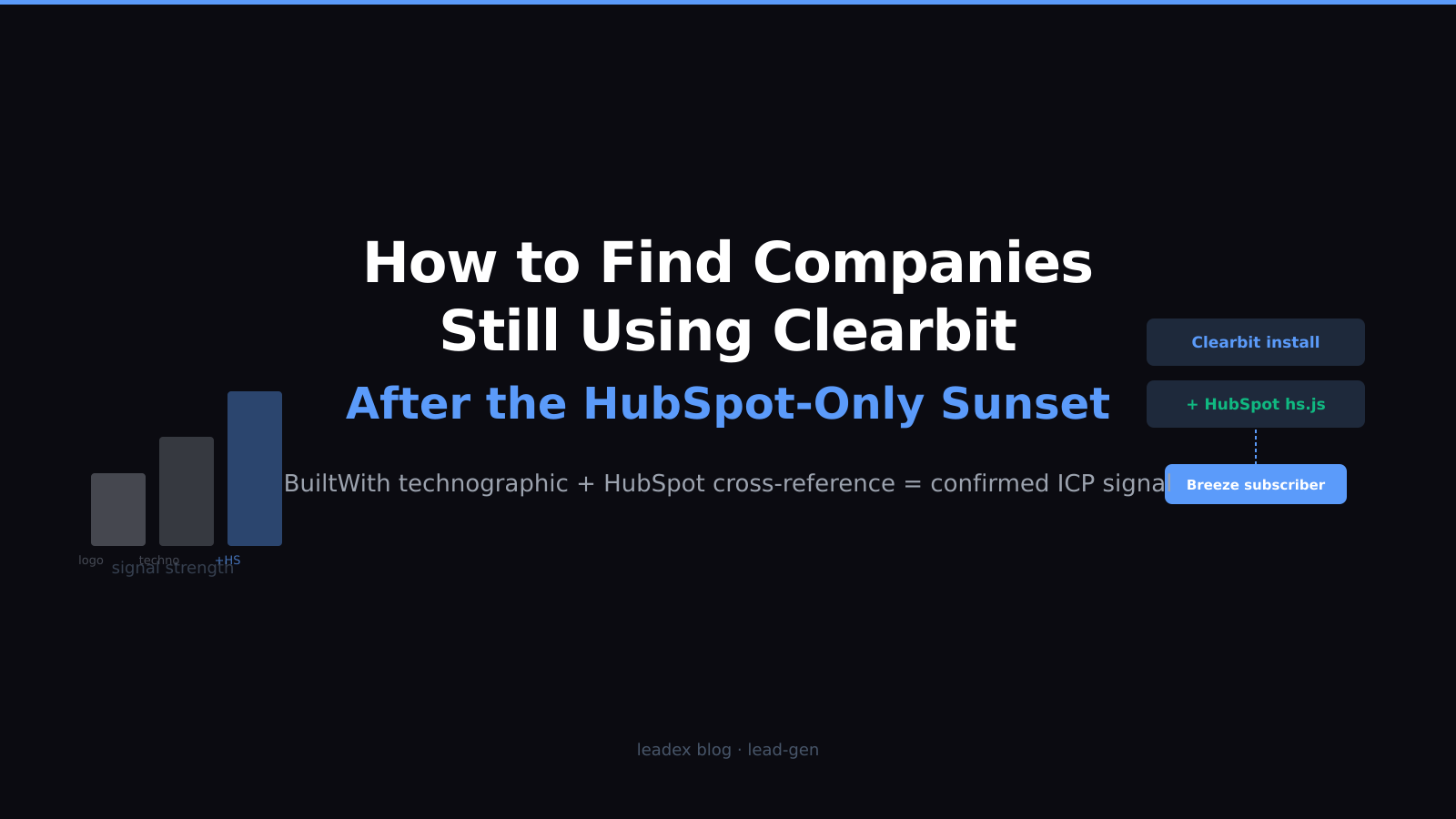
The short answer, as of mid-2026: run a BuiltWith or Datanyze technographic query for "Clearbit" installs, cross-reference with active HubSpot tracking code, and you have a filtered list of companies that are, by definition, paying HubSpot subscribers - because Breeze Intelligence (the HubSpot-only successor to Clearbit) requires a HubSpot account with no standalone tier. The rest of this post is the mechanics.
The shutdown happened in three stages. Clearbit Connect - the Chrome extension salespeople used to look up emails - went dark in December 2024. The free Clearbit platform, weekly visitor report, and Slack integration followed on April 30, 2025. Then on December 1, 2025, HubSpot sunset the last piece: the free logo.clearbit.com API that had been embedded in company websites, email templates, and prospecting tools across the internet for years. As the developer changelog noted at the time, the API would "no longer be available for new users" with no grace period after the December cutoff.
What that staged shutdown left behind is cleaner than it looks. Before the acquisition, standalone Clearbit served anyone - Salesforce shops, Pipedrive shops, custom stacks. The API worked regardless of CRM. After HubSpot folded it into Breeze Intelligence, that changed: enrichment is now available only inside HubSpot, as a credit add-on that requires an active subscription. There is no standalone tier, no API key without a HubSpot account. Every company still running Breeze Intelligence enrichment is, definitionally, a paying HubSpot customer.
For enrichment alternative vendors, RevOps consultancies, and anyone selling into the HubSpot ecosystem, the sunset created a prospecting signal worth paying attention to.
Why the Clearbit technographic is a confirmed HubSpot signal
Before the acquisition, roughly 1,500 business customers used Clearbit's paid enrichment tier alongside an unknown but much larger number using the free Logo API. The paid customers came from every CRM background. The logo API users were often not enrichment customers at all - they just needed company logos for their UI and grabbed the free endpoint because it was there.
Post-sunset, the cohort splits cleanly. The Salesforce and Pipedrive shops that were on paid Clearbit enrichment had to leave - Breeze Intelligence doesn't offer an API that works outside HubSpot. The logo API embedders either migrated to Logo.dev (the recommended replacement on the clearbit.com/logo sunset page) or left broken image tags in their templates. What remained is a core group of companies that (a) were already on HubSpot and (b) valued enrichment enough to keep paying for it under the new credit model.
That's the cohort worth finding. Breeze Intelligence pricing starts at roughly $45/month for 100 credits on top of a HubSpot subscription (minimum HubSpot Starter at $15-30/month), so the floor for an active Breeze enrichment user is around $60-75/month just for the data layer. Larger teams on HubSpot Professional or Enterprise pay considerably more. These companies are invested in the HubSpot stack and aren't leaving soon.
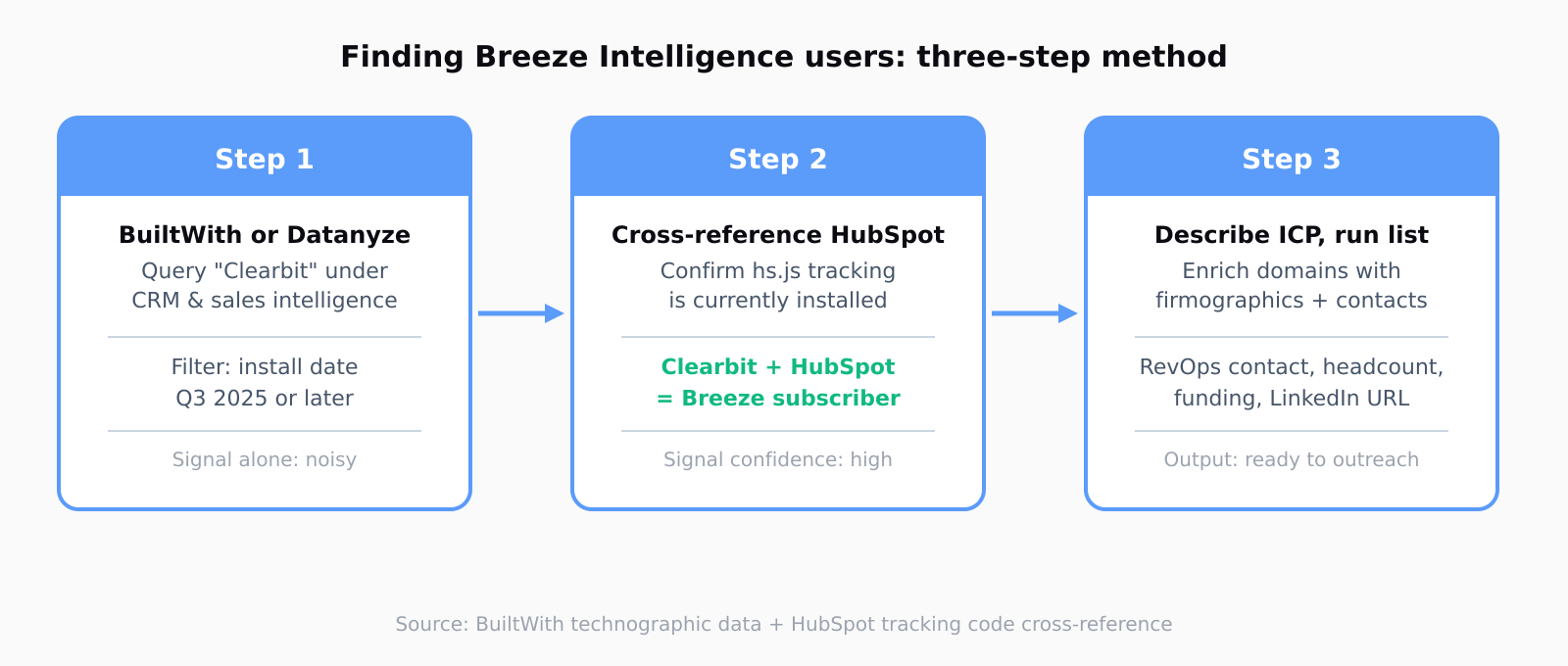
Step 1: Pull the technographic from BuiltWith or Datanyze
BuiltWith tracks Clearbit as an installed technology based on code signatures it observes when crawling company websites. That includes both legacy Clearbit asset references (logo.clearbit.com image sources, old Clearbit Reveal tracking code) and current Breeze Intelligence indicators that appear when a HubSpot-CRM site enables Breeze data enrichment workflows.
The practical query in BuiltWith's technology lookup:
- Search "Clearbit" under the CRM and sales intelligence category
- Filter by install status - BuiltWith distinguishes "currently using" from "historically used." Historical Clearbit installs through late 2025 are still useful post-sunset, because a company that had Clearbit embedded as recently as Q3 2025 and still shows HubSpot tracking code almost certainly migrated to Breeze rather than leaving HubSpot entirely.
- Layer on firmographic filters: employee count, country, industry. For most sales-intelligence ICP plays, 50-500 employees in North America or Western Europe covers the segment where Breeze Intelligence adoption is strongest and where Clearbit's data accuracy was historically best.
- Export the CSV - it includes domain, technology install date, and current vs. historical classification.
Datanyze's Chrome extension covers similar ground for single-domain lookups and is useful for quick validation of high-priority accounts before running a full export. Wappalyzer's site inspector is another fast option for live domain-level confirmation that HubSpot is currently installed.
Step 2: Confirm active HubSpot with a secondary signal
The raw Clearbit technographic is noisier than it looks. The free Logo API was embedded by thousands of companies that were never Clearbit enrichment customers - it returned company logos by domain, was useful as a free utility, and required no paid relationship. An `<img src="https://logo.clearbit.com/domain.com">` reference in someone's HTML confirms they used the free API, but says nothing about whether they're now on Breeze Intelligence.
The fix is cross-referencing with a second technographic. BuiltWith and Datanyze both track HubSpot's JavaScript tracking code (`hs.js`) as a separate, currently-installed technology. A company with both "Clearbit" in its BuiltWith profile and current HubSpot tracking is, with high probability, an active Breeze subscriber. The company that just had the logo API in an old email template and has since moved its CRM to Salesforce won't have HubSpot tracking active.
This two-signal approach is the same logic behind the tech stack displacement signal playbook more generally - one technographic tells you a company used something; the second tells you whether they're still invested in the platform. When both signals are present, the confidence level is materially higher than either alone.
One counter-take worth acknowledging: some companies that genuinely migrated to Breeze Intelligence may have removed all Clearbit-branded assets from their site during the transition, so they'd show HubSpot tracking but no Clearbit reference. For those, a keyword search on job postings - specifically "Breeze Intelligence" or "HubSpot enrichment" in RevOps or marketing operations roles - can surface companies actively working with the tool even if their BuiltWith profile has been cleaned up.
Step 3: Build the ICP brief and run the list
Once you have a filtered list of domains with confirmed Clearbit/Breeze Intelligence and HubSpot tracking, the remaining work is enriching those domains into a proper contact list. The technographic gives you the qualifying condition; firmographic enrichment fills in headcount, funding, and the right decision-maker titles.
A typical ICP brief that would work for an enrichment alternative vendor:
Find 200 B2B software or professional services companies in North America that use HubSpot and had Clearbit or Breeze Intelligence in their tech stack in 2024-2025, with 50-500 employees. I want company name, domain, estimated employee count, the Head of RevOps or VP of Operations (whichever exists), and their LinkedIn URL.
For a RevOps consultancy, the brief shifts slightly toward companies where Breeze Intelligence is likely sitting idle - mid-market HubSpot teams without a dedicated data engineer who can actually configure enrichment workflows. That's roughly the 50-200 employee range, outside of major metro areas where RevOps hiring is thinner. The Breeze Intelligence tier breakdown we covered previously explains why these teams often have enrichment credits sitting idle: they're on HubSpot Professional because they needed marketing automation, not because they planned to build enrichment workflows, and the Breeze add-on was a natural upsell that nobody owns internally.
For the enrichment waterfall angle - building a contact list of companies that might want an alternative to Breeze - the play is slightly different. These are teams that are actively frustrated with Breeze's credit system or coverage gaps (particularly for international contacts, where Breeze data accuracy drops off). A multi-provider enrichment waterfall that pairs Clearbit with Apollo or Cognism for fallback coverage is a natural pitch into that segment.
Leadex handles this kind of cross-signal brief from a single prompt. Describe the ICP - North American B2B companies, 50-500 employees, active HubSpot plus Breeze Intelligence tech stack - and the agent composes results across technographic sources, enriches with firmographics and contact names, deduplicates, and typically completes a batch in under 60 seconds. The multi-source composition that previously required four separate tool subscriptions is the workflow Leadex was built for.
FAQ
Can I still use the Clearbit API in 2026?
No. The standalone Clearbit enrichment API, Person API, and Company API endpoints are all deprecated. Clearbit Connect (the Chrome extension for finding contact emails) ended in December 2024. The free Logo API went offline December 1, 2025. If you were calling these endpoints directly, you need to migrate to a replacement - Apollo, Clearout, Enrich.so, or a similar enrichment provider with its own API layer.
Does a logo.clearbit.com image on a site mean the company uses Breeze Intelligence?
Not necessarily. The free Logo API was embedded by a large number of companies that were never paid Clearbit enrichment customers - it returned company logos by domain, was genuinely useful as a free utility, and required no commercial relationship. A clearbit.com logo reference in a company's HTML confirms historical API use but not current enrichment usage. Cross-reference with active HubSpot tracking to confirm a live subscription before treating it as a high-confidence ICP signal.
How accurate is BuiltWith's Clearbit data after the December 2025 sunset?
Post-sunset, BuiltWith typically marks Clearbit as a historical install for sites that removed the asset references. The more reliable filter is BuiltWith's HubSpot data layered with any Clearbit reference dated Q3 2025 or later - the combination catches companies that were actively using paid Clearbit enrichment in the months before the final shutdown and almost certainly migrated to Breeze rather than switching CRM platforms.
What's the best way to find HubSpot customers for prospecting without buying a list?
BuiltWith, Datanyze, and Wappalyzer all detect HubSpot's JavaScript signature as a current technographic. Free tiers on each return limited results; BuiltWith's paid tier (starting at $295/month) returns the full install list by category with historical depth. The Clearbit-plus-HubSpot approach in this post is a useful narrowing filter on top of a general HubSpot query - it selects for the subset with active enrichment workflows, which tend to be more operationally mature and more likely to respond to RevOps-adjacent pitches.
What other signals should I watch alongside the Clearbit technographic?
Job postings for "RevOps," "HubSpot admin," or "marketing operations" roles from companies in your Clearbit export indicate active investment in the platform. Recent funding - particularly a Series A or B for a software company - paired with a Breeze Intelligence install suggests a team scaling into its HubSpot stack and likely evaluating data quality at the same time. The general tech stack displacement signal playbook covers how to extend this approach beyond Clearbit to other enrichment tools with similar migration histories.