Why AI SDR Outreach Reads Generic and How to Fix the Knowledge Base Gap in 11x Alice
The Alice FAQ asks the question directly. The answer is a thin knowledge base, not a model problem. How to populate the four inputs for specific claims.
If you've read an email from an AI SDR and thought "this is well-written, but it could have been sent to anyone at a hundred other companies," you're not alone. The prose is grammatically clean, the research reference checks out, and the claim about the product is a category-level statement - "teams like yours struggle with pipeline" - that any vendor could have written.
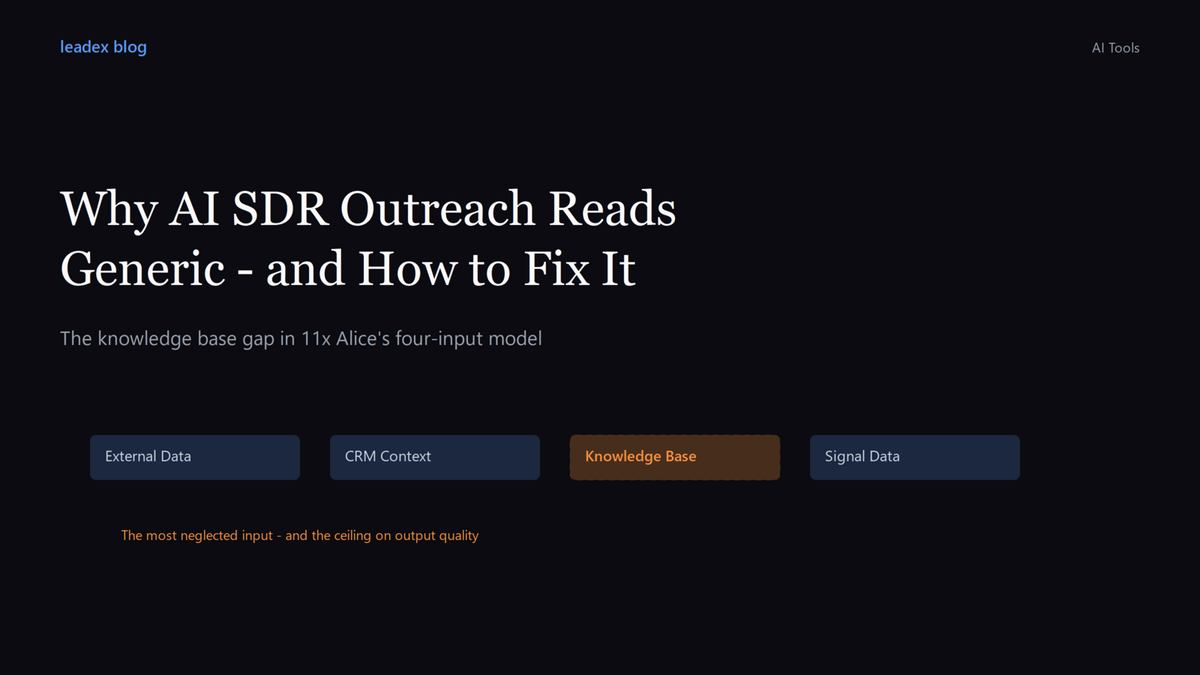
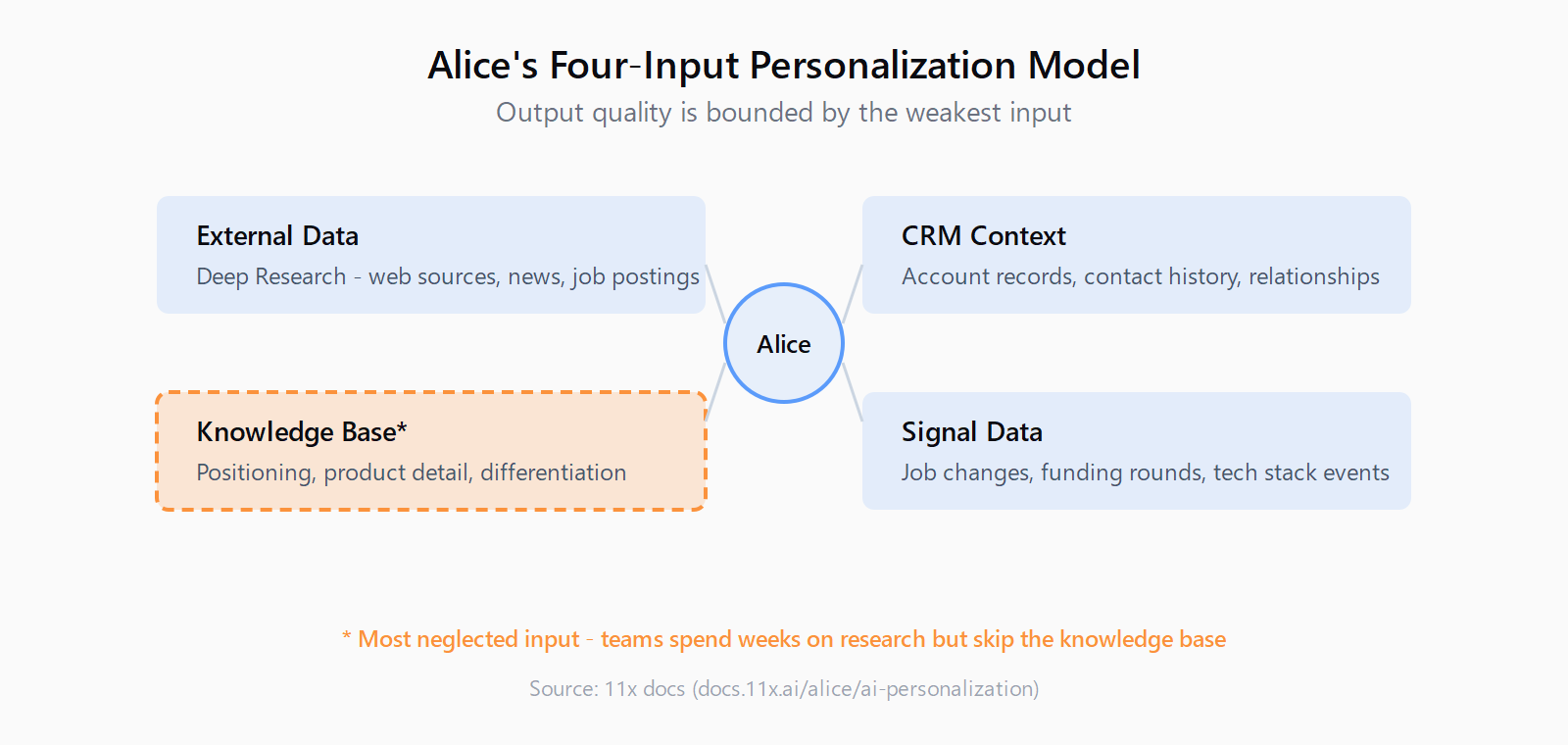
11x's own documentation knows this happens. The Alice FAQ page asks the question directly: "Why does Alice's outreach read generic?" The answer is structural, not a copywriting problem. Alice generates messages from four inputs - external data, your knowledge base, CRM context, and signal data - and the output is bounded by the weakest of the four. Teams invest in external research and neglect the knowledge base, producing messages that reference a real company event but then make a generic claim about the product.
11x is blunt about where the problem lives. From the knowledge base documentation:
Generic outreach is almost always a thin-knowledge-base problem, not a model problem.
I've seen this pattern across three AI SDR deployments now. The team spends weeks tuning the ICP and configuring deep research directives, then uploads a single PDF of the homepage and declares the knowledge base done. The model can research a prospect's entire technology stack, but it doesn't know how your product differs from the competitor they're also evaluating, because nobody told it.
How the four inputs work and where the gap forms
Alice's AI personalization system synthesizes four inputs: external data from Deep Research, the knowledge base of your positioning, CRM context from your account records, and signal data from job changes and funding rounds. The AI personalization documentation explains that the system adjusts length and structure by channel, and frames the same value differently for a CFO versus a VP of Sales based on the persona mapping in your ICP configuration. The gap forms because the four inputs are not equally easy to improve. External data is the obvious lever, CRM context is already there, signal data flows in from integrations. The knowledge base is the only input that requires you to write something from scratch, and it's the one teams skip. The result is a message that opens with a perfectly researched signal - "I saw that you just closed your Series B" - and then transitions into a claim any competitor could have written.
How to populate the knowledge base for specific claims, not category claims
The knowledge base accepts PDFs, documents, URLs, call transcripts, and battle cards. 11x's documentation lists six areas to cover: positioning, product detail specific enough to make a concrete claim, competitive differentiation, objection handling, proof points, and boundaries - claims Alice must never make. The most underused source is call transcripts. They contain the objections your buyers actually raise and the words they actually use, which is exactly what makes outreach sound like a person wrote it. I've watched a team upload a single transcript of a discovery call and immediately get better variation in Alice's output, because the model learned the language their real prospects use instead of the language their marketing site uses. Product detail is the second most neglected area. If your knowledge base says "we automate sales workflows," Alice will write "we automate sales workflows." If it says "we score inbound leads by intent signal and route them to the right rep within 90 seconds of form submission," Alice will write something specific about lead scoring speed.
How to configure Deep Research directives for sharper context
Deep Research builds per-prospect context from web sources, news, job postings, and your CRM data, producing a research report with cited findings and a recommended messaging angle. The default research is accurate but generic; the customization lever is directives, which tell Deep Research what to look for. The Deep Research documentation gives examples like "research 10-K for Gen AI initiatives" and "focus on compliance pain points." The guidance is to write directives from your qualifying questions - whatever a good rep would want to know before a first call is what the directive should ask for. Directives that surface a problem give Alice something to write about; directives that surface trivia give her something to mention. 11x also notes that job postings are the highest-signal public source for most B2B products - what a company is hiring for reveals what it's building and struggling with, often before anything is announced.
How to use review mode to calibrate before going autonomous
Alice has three autonomy levels: review each message, approval workflow, and autopilot. The documentation advises against starting on autopilot: "Review the first sample, fix what the output reveals about your inputs, then graduate." Review mode is a diagnostic tool. Every message you review tells you something about your inputs. If Alice makes a factual claim that's wrong, the problem is in Deep Research or your CRM data. If Alice makes a claim about your product that's technically true but too generic, the problem is in the knowledge base. If the tone is wrong for your market, the problem is in the persona mapping. 11x's suggested test is to read five messages in a row. Individually good messages that are structurally identical still read as automated, so variation across prospects is the signal that your inputs are working. This is the same audit discipline you'd apply to scoring email quality without letting the score flatten your voice.
How persona-aware framing makes multi-threading work
Persona-aware framing is the feature that makes Alice sound like someone who understands the buying committee. A CFO and a VP of Sales at the same company get different messages because they're typed differently in your ICP configuration. Sending the same message to four people on a buying committee is transparent and counterproductive; sending four role-appropriate messages is how ABM is supposed to function. If every contact is typed the same way, they all receive the same message - which is exactly the pattern that makes an AI SDR sound like an AI SDR. It's the same failure mode I've documented for autonomous AI SDRs in general: the tool is only as differentiated as the framing you give it.
The counter-argument worth taking seriously is that personalization is overrated and generic outreach still works for volume plays. A well-written generic message sent at scale can outperform a personalized message at lower volume. That's a defensible position for a broad ICP and a commoditized product. But if you're selling a differentiated product to a specific audience, a generic message is indistinguishable from the other fifty your prospect got that morning. The knowledge base investment is the investment in being the one message that doesn't sound like the other fifty.
We think about this seam constantly at Leadex, because Leadex sits at the point where discovery ends and personalization begins. The research that feeds an AI SDR only produces specific output if the input is specific - Leadex pulls from your connected providers and your own criteria, so the signal your AI SDR personalizes on is the segment you actually pursue, not a generic lookalike. That's the same principle 11x applies to its knowledge base: what enters the system is the ceiling on what comes out of it.
FAQ
Why does Alice's outreach read generic even when the research is accurate?
Because the research is accurate about the prospect but the knowledge base is thin about your product. The fix is expanding the knowledge base with specific product detail and differentiation.
What should I upload to the knowledge base first?
Start with call transcripts and product positioning documents. Call transcripts give Alice the language your real buyers use, and positioning documents give her the specific claims your product can support.
How many prospects should I review before switching to autopilot?
For Deep Research review, 11x recommends a sample of 15-20 prospects. For message review, read five in a row and check whether the structure varies. If every message follows the same pattern, your knowledge base is thin.
Does the knowledge base also affect Julian's inbound calls?
Yes. Both workers pull from the same knowledge base, so the answer in Alice's email and the answer on a call with Julian come from one source. Divergent positioning between outbound and inbound is a credibility problem that's hard to detect from inside.
Can Deep Research alone make outreach feel personalized without a full knowledge base?
Not for a differentiated product. Deep Research finds accurate facts about the prospect, but without product-specific knowledge base content, Alice can only make category claims. The knowledge base is what makes an AI SDR sound like a specialist instead of a generalist.